| Written by Reinhard Bonnke |
|
A story from Reinhard Bonnke’s autobiography “Living a Life of Fire” The footbridge had no stabilisers, no supports to keep it from swaying. It stretched dangerously above a deep, rocky chasm. The walkway had been constructed of two cables with wooden slats strung between them, nothing more. There were not even any handrails. To my way of thinking, this bridge was not a proper crossing. It was a deathtrap. I would not think of stepping onto it. It was then that I noticed a foolish soul attempting to cross. Like a high-wire amateur, the man held out his arms for balance. He crept, inch by inch, toward the other side, staring down at his trembling legs and feet. The wooden walkway tipped and swayed beneath him. I rushed to the edge of the cliff and looked over. The bottom of the gorge could not be seen below. It was covered in morning mist. The fog moved like a river through this great gash in the earth. I looked back at the man. He had made surprising progress, bringing himself nearly halfway to the other side. In my heart I wished him well, but suddenly the cloud of fog rose on an updraft from the canyon. It engulfed the walkway just in front of the man. He was unaware of it. His eyes were trained on his own feet and I knew as surely as I breathed that if that man stepped into the fog he would lose his balance. He would plunge to his death. I rushed to the base of the bridge to see if I could rescue him. Arriving there, I could see that if I placed one foot on that rickety walkway it would totally destroy the man’s equilibrium. I could only warn him. “Sir, stop!” I shouted. “You must stop! The fog is in front of you.” The man turned and glanced back at me. That moment, a shaft of pain stabbed through my soul. The man was my own brother, Jürgen. Ignoring my warning, he turned quickly and disappeared into the fog. “Jürgen! Jürgen!” I cried. Suddenly I heard a cry and then a terrible scream. It faded and echoed below as he fell. “Reinhaaaaard!” I woke up. My sheets were drenched in sweat. My heart pounded in my chest. A thousand buried feelings rose up in my heart and washed over me. I wanted to weep aloud for Jürgen. I knew that he had wandered far from Jesus. Lord, what have I seen? The answer was clear and specific: “Jürgen is on the bridge to eternity. If you don’t warn the godless man, I hold you accountable for his death.” I objected. Lord, this makes no sense. I know Jürgen is far from you, but how can I warn him when he knows the way of salvation as well as I do? If you don’t warn the godless man, I will hold you accountable for his death. Why did I question God? I don’t know. Perhaps I reacted like the Virgin Mary when the angel Gabriel announced that she would have a baby. It made no sense to her natural mind. She said, “Lord, how will this be since I have never known a man? This is not a question of unbelief, but a question of how to obey. Jürgen and his twin, Peter, were close in years and experience to me. We remember many things alike. They were nearly six and I was five when we were forced to flee for our lives at the end of World War II. Mother prayed and read her Bible every day for guidance and protection. We survived the internment camp together. When released from military duty, our father became a Pentecostal pastor and we were soon reunited with him. However, as the years passed by, all my older brothers – Martin, Gerhard, Peter, and Jürgen – began to question the family faith. Even the stories of our deliverance at the fall of East Prussia was questioned. They found other natural ways to explain our escape at the end of the war. It was not the hand of God, they said, it was chance, luck, coincidence, fate – anything but God. Even our father’s healing from tuberculosis could be explained in terms of psychology and psychosomatic symptoms, they decided. I know that this is a familiar story. It happens in many families. Some children remain true to the faith while others go astray. The Bible repeats a sad phrase from the history of God’s people: “… and they forsook the Lord, the God of their fathers, who had brought them out of the land of Egypt. This scripture came true before my eyes as Jürgen and I grew up. He and my older brothers forsook the way of the Lord. It was hurtful for me. My younger sister, Felicitas, and I were part of that same family and we held to the faith of our parents until it became completely real to us. What made the difference? There are probably as many explanations as there are families. I know that in Germany after the war there was much blaming. Everything from the older generation came under criticism. Our father’s claims about God’s miraculous favour were placed in the same basket as death camp discoveries and other wartime Nazi horrors. “Where was God?” my brothers asked. “Do we think the Bonnkes were his favorites? We were allowed to escape, while thousands of others died around us! What kind of God would do that?” With questions like those, my brothers rejected faith and began to worship intellect and science. They were determined never to make the same mistakes as the older generation in Germany. They saw belief in the Lord as something easily manipulated and they wrongly thought that by using their minds they would rise above it. They invested themselves in schooling as I began to invest myself in our father’s church activities. Our paths went east and west. In recent years while building CfaN, I returned to Germany a number of times. My heart would hurt as I saw so many decisions for Christ around the world, yet my own brothers were still completely hardened to the gospel. … Why are you now telling me, “If you don’t warn the godless man, I will hold you accountable for his death?” What do you mean? Am I to preach him the sermon he has heard a thousand times? Will he learn anything new if I tell him again he is a sinner and bound for hell? He knows that you sent Jesus to die for his sins. I don’t understand. The Lord whispered to my heart, “Write him a letter and tell him what you have seen in this dream.” Yes! That sounded like God speaking to me. It was not an idea that would have occurred to my natural mind. “I will do it, Lord”, I said. I turned over and went back to sleep. The next morning I woke up and started another day with the family. In all of the normal excitement of preparing to move to Germany, I forgot about my dream. Suddenly, in the middle of the day, I heard the Holy Spirit speak clearly to me. “You have not written the letter. I will hold you accountable for his death.” I stopped everything. Excusing myself for a few minutes, I sat down and wrote that letter, telling Jürgen what I had seen in the dream. Then I sent it via airmail. As the weeks went by I did not hear a reply. I left it in God’s hands. I had obeyed. Now I went on with my life and eventually it left my mind. … We settled into our new headquarters in Frankfurt. Immediately, things began to improve on every side. We found that our German passports and visas were universally accepted. Money transfers were seamless. Airline ticketing unquestioned. All the sanctions that were leveled against South Africa disappeared from our operation as soon as we changed our address. This confirmed the wisdom of the decision. Finances also improved. While our South African support fell to just 5 per cent of its former level, German and UK supporters increased in even greater numbers. It was as if they suddenly thought of us as one of their own with our headquarters now located in Europe. We had not anticipated that. The benefits of relocating continued to pile up. When Anni and I returned from Harare, waiting for us at home was a huge stack of mail. We gathered the children – Freddy, Susanne and Gabriele – to sort it out. The children were anxious to hear from the friends they had left behind in Witfield, and so were we. After spending some time sifting through it, Anni came to me and dropped a hand-addressed envelope in my lap. “You had better read this one right away,” she said. I took the envelope and examined the address. It was from Jürgen Bonnke. Suddenly I remembered how I had written to him from South Africa weeks ago. I had heard nothing back, and in all the excitement of the Harare Fire Conference I had forgotten about it completely. Now, here in Germany came this letter. Anni and the children knew how important family communication was to me. They gathered around, eager to see what “Uncle Jürgen” had to say. I ripped open the envelope and unfolded the document inside. “Dear Reinhard, My wife has left me. My best friend recently died of cancer. I have been so frustrated I felt that life was no longer worth living. I wanted to kill myself. But in the night I had a dream. I was walking on a bridge. It was unstable and had no handrails and I slipped and screamed as I fell. I woke up, sweating with fear …” At this point my voice became husky with emotion. Anni and the kids did not understand this. They did not know that Jürgen was describing my dream. I had said nothing to them about it. I continued reading … “I jumped out of bed and said, ‘Almighty God, you know that I don’t even believe in you, but I have a brother who serves you. If you have spoken to me through this dream, speak to me through Reinhard.’ Sometime later your letter came. Your dream was my dream. I have given my life to Jesus. He has forgiven me my sins …” At this point I was weeping and could not even talk. I could not help myself, and it took quite an effort to bring Anni and the kids up to date on the details behind Jürgen’s story. Once they understood, however, they shared my tears and my joy. This kind of thing prostrates my soul before the King of kings and Lord of lords. It reveals his great heart of love for us. The ties that bind a family together must surely mean more in the Spirit than we can know in the flesh. God had linked us together even though we were 5,000 miles apart, causing us to dream the same dream. This is so much more than coincidence. God spoke to me, telling me to share the dream in a letter. I almost neglected his still small voice. Today, my brother Jürgen is saved, yet he is also a broken man. His health is gone, his mental abilities nearly wiped out. He lives in a nursing home. But soon – perhaps by the time you read this story – he will be face to face with the Lord we both long to see. I am so happy. In conclusion, I have three things to say concerning your Unsaved Loved Ones. They are three things to remember when you find yourself thinking “There’s no way it’s going to happen”. Three thins to bring to the forefront of your mind when you feel exhausted, worn-out and without hope. These three things that can make all the difference to their eternal salvation. Those three things are
Reinhard Bonnke
|
Friday, June 7, 2013
Parabel: The footbridge

What is the secret to accessing the miraculous?
| Written by Daniel Kolenda |
|
I was interviewed on a well known television show and was asked by
the host “What is the secret to accessing the miraculous?” My first
thought was, “I wish I had 30 minutes to talk about this instead of 30
seconds.” The reason is that I know that many people will dismiss my
simple and un-convoluted answer as a corny spiritual cliché. “The secret”, I told him, “is that there is no secret.” Or at least, it shouldn’t be a secret. The key to accessing the miraculous power of God is the simplest and most basic belief of Christianity. It is what brings us into the kingdom of God, justifies us before God and allows us to please God in the first place. The key to accessing the miraculous is simply faith in the finished work of the cross. I know no other secret and I challenge anyone to point to anything in Scripture that gives us any other key to accessing the miraculous power of God besides faith. Remember when the lame man at the Beautiful Gate was healed? Peter said to the crowd of amazed spectators that gathered, “Why do you stare at us as if by our own power or godliness we had made this man walk? By faith in the name of Jesus, this man whom you see and know was made strong. It is Jesus’ name and the faith that comes through him that has given this complete healing to him, as you can all see.” (Acts 3:12 and 16) The greatest spiritual discoveries are really simple and basic truths. It is as if everyone were searching for a tip, a trick or a new revelation. The new books keep piling up. Training centres are springing up everywhere. Teachers are a two a penny. Yet it seems that the more we learn about the miraculous the less we experience it. Perhaps what we really need is to unlearn most of what we have learned – to strip it all back to the utter simplicity of God’s word. I am talking about a simplicity that is so elementary that it is offensive, an insult to our intelligence. The incalculably priceless originalIn ancient times writing materials were often difficult to come by. For this reason parchments were often re-used for different purposes. A scribe or an author would simply scrape or scrub out the original text that was inscribed on the parchment and write something else over the top of it.Believe it or not, incalculably priceless New Testament manuscripts were sometimes recycled in this way, much to the chagrin of anyone who recognised their real value. These came to be known as “palimpsest” manuscripts (from a Greek word meaning “scraped again”). Scholars have gone to a great deal of trouble to transcribe the underlying text of these palimpsest manuscripts using keen eyesight, chemical reagents and, more recently, computer technology. Perhaps the most famous palimpsest manuscript is known as the Ephraim Codex. It is so called because at some point around AD 1,200 someone copied 38 sermons by the 4th century theologian, Ephraim of Syria, over the top of much of the biblical text! Thanks to the German Bible scholar Tischendorf, who first deciphered the manuscript, the Ephraim Codex is today among the most significant biblical manuscripts in existence. I am sure the scribe who superimposed Ephraim of Syria’s sermons over the top of the biblical text thought he was doing something important. If he had only understood that the real treasure was the original text underneath! To reach the treasure, great pains were taken to peel back the layers of overlaid commentary to reveal the simplicity and the power of God’s word. If there is a secret to accessing the miraculous power of God, it is a secret because it has been obscured by the commentaries of a thousand teachers, each one adding to the infinite list of prerequisites, regulations and procedures that are now being taught as necessary. If we can only forget all that and strip it all back to the basics, we would discover the secret has been there all along: “Only Believe”. My friend, if you are searching for the secret, I can tell you already – when you discover the secret, you will discover that the secret is really no secret at all. A tough lesson in faithSeveral years ago I ministered at a remarkable event. I had just finished preaching my heart out and it was time to pray for the sick. Little did I know, I was about to learn a new lesson in the subject I had just preached about – faith. Fired up by my own sermon and brimming with confidence, I stepped off the platform and began laying hands on the sick who were sitting right in the front. I approached a severely crippled man in a motorised wheelchair. His hands and legs were twisted, shrivelled and lame. I turned to the ushers who were flanking me and said, “Lift him out of the wheelchair!” and I continued down the prayer line.I am not sure what caused the misunderstanding that took place next. Perhaps it was the language barrier – we were in Hong Kong. Perhaps it was the noise – it was a very noisy meeting at a huge venue. I am not sure. All I know is that after I had laid my hands on the last person in the front row, I turned back towards the stage and now that man in the wheelchair was sitting right in the centre of the stage in front of over 5,000 people! Apparently, when I told the ushers to lift him out of the wheelchair, they thought I had told them to lift the wheelchair onto the platform. Now, it is one thing to pray for a person on the front row but it is another to pray for them while 5,000 people are watching every move. My legs felt a little wobbly, my palms began to sweat and my heart rate went up. What if I pray and nothing happens?All that faith that I thought I had was suddenly missing. I am sure you want to know what happened next. I have to warn you – this is not what you were hoping for. I prayed for the man and nothing happened. No healing. No miracle. No manifestation. Nothing.I want to be very honest with you. Sometimes the most important lessons are not learned on the mountaintops but down in the valleys. I want you to understand something about faith that is very valuable and if you will receive what I am telling you now, it can set you free. After I prayed for that crippled brother and he was not healed, I have to admit that I felt humiliated, embarrassed, ashamed and depressed. I think that I actually felt worse for myself than for the crippled man! In that moment, the Holy Spirit shone a light on my own heart and I saw something I had never been aware of before. I suddenly realised that I had hitched my reputation and ego to the train of God’s glory. If he did a miracle, I felt gratified. If he did not do a miracle, I felt humiliated – as though I had some stake in his wonders. In my view, this is the most common mistake that people make when expecting miracles to happen. Miracles are not about us. Miracles are all about Jesus! People are amazed to see the miracles that happen at our campaigns but I truly believe that I could stand my seven-year-old son on the platform in my place and if he prayed in faith in the name of Jesus, he would also see mighty miracles. Miracles are the easiest part of my job because I do not perform them! Most people reading this text will never have to pray for someone on a platform with 5,000 people looking on but many have the same fear and it has often kept you from stepping out in faith. “What if I pray for someone and nothing happens?” is the question. Years ago I asked Evangelist Bonnke that same question, “What if I pray for someone and nothing happens?” This was his answer, “If you have to pray for 100 people in a prayer line and the first 99 don’t get healed, pray for the 100th one as if everyone before him had been healed!” My friend – that is faith! It is unmoved by what the eyes see. It rests on the promises and power of God. Someone once said to me, “Faith is spelt R-I-S-K.” I know what they meant by that and there is certainly truth in it. But I would like to express it differently. I say faith is spelt R-E-S-T. Or perhaps to put it a better way, T-R-U-S-T. If you are always afraid of what will happen if you pray for someone and they are not healed, you will soon stop praying for people. Faith and fear are at opposite ends of the spectrum and fear is bondage (Hebrews 2:15). Fear enters in where there is a feeling of personal risk. So if you are afraid of what will happen if you pray for someone and they are not healed, it is a good indication that you may have claimed personal ownership of something that does not belong to you in the first place – God’s glory. Until you are able to rest in the finished work of the cross, you do not understand faith. Until you are able to be unmoved by what you see, you do not understand faith. Until you have unhitched your reputation from the train of God’s glory, you do not understand faith. Until you understand that it is not about you, you do not understand faith. I do not claim to know all there is to know about faith. In fact, the longer I am enrolled in the School of the Holy Spirit, the less I know. But there is one thing I am sure of – once I had unhitched my ego from the train of God’s glory, I experienced a freedom that I had never known before. Now I could pray for the sick without feeling any pressure or anxiety. If they were healed it was not my doing and if they were not healed it still was not my doing. I relinquished both the credit and the blame. What was important for me to do was simply to obey and to believe and the rest was his responsibility. Do you know what I discovered? I discovered that faith is rest! What a liberating truth! The more we try to make miracles happen the less we will see them. The more afraid we are of what might not happen, the less we will pray, obey and believe. The more we rest in faith and move forward in obedience, the more we will experience the miraculous. Our job is not to be the saviour, the healer, the wonder worker or the deliverer. Our job is to lay our hands on the sick, to pray for them in Jesus name and to believe God’s word no matter what. The rest is up to God. So, in answer to the question “What if I pray and nothing happens?”, here is my advice: Keep praying!Daniel Kolenda |
Isaiah’s Prayer Answered
| Written by Daniel Kolenda |
|
One of the most remarkable prayers of intercession recorded in the
Bible is found in Isaiah 64, where the prophet calls upon the Lord,
saying, “Oh, that you would rend the heavens and come down, that the
mountains might quake at your presence – As fire kindles the brushwood,
as fire causes water to boil – To make your name known to your
adversaries, that the nations may tremble at your presence!” (Isaiah
64:1-2 NASB). The word “rend” means to tear or to tear open. Isaiah was crying out to God that He would “tear open” the heavens and show Himself to the world so that the world might see Him as Isaiah had seen Him! Isaiah’s passion is seen in his expression, “Oh.” In this prayer for God to “rend the heavens and come down”, I believe that Isaiah was reflecting on a previous experience in his life, recorded in Isaiah 6:1-8, in which he had been caught up into heaven and received the commission and anointing for his life and prophetic ministry. He recalls it, saying, “In the year that King Uzziah died, I saw also the Lord seated on a throne, high and exalted, and the train of his robe filled the temple” (Isaiah 6:1). Isaiah continued in the following verses to describe his experience in God’s presence. He spoke of angelic beings around the throne crying out, “Holy, holy, holy, is the Lord Almighty; the whole earth is full of his glory” (verse 3). He spoke of the visible manifestation of God’s glory. He described his sudden and overwhelming awareness of sin when he stood in the magnificent presence of the holiness of God. He thought he would surely die in such a holy place where he had suddenly found himself! But he also found grace there, and his sin was purged with holy fire. It was in this place that his life and destiny were forever changed. He would never be the same again! Pay careful attention to what the angels were crying to one another. Notice, they did not say, “Heaven is full of his glory.” Rather, they said, “The earth is full of his glory.” This was a prophetic insight into a time that is coming, of which Scripture says, “For the earth will be filled with the knowledge of the glory of the Lord, as the waters cover the sea” (Habakkuk 2:14). When Isaiah prayed for God to rend the heavens and come down, he was asking for the fulfilment of the prophetic promise he had received in his vision many years earlier. He was saying in essence, “Lord, if the earth is going to be filled with your glory, you must rend the heavens and come down!” Isaiah realised that this “rending of the heavens” would be necessary for God to fulfill His plan for this world. Many people still pray Isaiah’s prayer for God to rend the heavens and come down, pleading despondently like a beggar dejectedly crying for a piece of bread. But my friends, the good news is that the prayer of Isaiah was answered 2,000 years ago! God truly did rend the heavens and came down through Jesus Christ. Could there be a more dramatic rending than the one that happened at Calvary? God has rent the heavens and has come down. He has destroyed that ancient barrier between heaven and earth, and today all the riches and resources of God are available to the one who will take them by faith through prayer. Hebrews 10:19-22 says: “Therefore, brothers, since we have confidence to enter the Most Holy Place by the blood of Jesus, by a new and living way opened for us through the curtain, that is, his body, and since we have a great priest over the house of God, let us draw near to God with a sincere heart in full assurance of faith, having our hearts sprinkled to cleanse us from a guilty conscience and having our bodies washed with pure water.” God wants us to approach Him in prayer with assurance and confidence in His all-sufficient provision. Today we can march boldly into the presence of God with a pure conscience and a heart full of faith, knowing that God has already destroyed everything that stands between Him and us by the blood of Jesus Christ. He truly has given us the keys to the Kingdom of Heaven. That is the true message of Christmas! Isaiah’s prayer was answered. The Lord came down. He became a man! He became one of us! He came in person – for you and for me. What wonderful truth! Daniel Kolenda |
Prayer - the power to change things
| Written by Reinhard Bonnke |
|
Let me encourage you to read the New Testament and mark every place
where prayer in mentioned. You will soon see the importance given to
prayer. In Matthew’s Gospel alone there are more than 40 references to
prayer; there are 230 in the New Testament as a whole, although as many
as ten different terms are used for prayer. There are various methods,
forms and types of prayer – and they exist so that we can use them
against the enemy. Today I would like to write to you about intercession. Intercession is a particular form of prayer for believers. What exactly is it? Intercession is a special commission for Jesus’ disciplesBelievers are called to do a particular kind of “work” through their prayers. They should not only ask for things for themselves but stand before God on behalf of other people. That is a key aspect of the fulfilment of Jesus’ commission on earth. It is prayer that first sets things moving in the spiritual world. Jesus Himself is our great intercessor and we are called to follow Him determinedly in that respect, too.However, “the work of prayer” is not enough on its own; we need more if we are truly to enter into intercession. From Jesus, our role model, flowed a great stream of compassion. It was the power motivating Him. The active power inherent in intercession grows out of a spontaneously overflowing sense of mercy and love. These are usually quite natural feelings when it comes to our own family and friends, but it is good to allow the Lord to lay other things on our hearts, too. If we sense the burden of intercession, it means that God would like to entrust something important to us. This is the confidence we have in approaching God; that if we ask anything according to his will, he hears us. And if we know that he hears us – whatever we ask – we know that we have what we asked of him. (1 John 5:14-15) The Old Testament gives us impressive examples of intercessory prayer. Abraham prayed to God for Abimelech and for the cities of Sodom and Gomorra, which were destined for destruction. Moses, Solomon, Elijah, Ezekiel, Daniel, Ezra, Esther, Jeremiah and many other prophets prayed for the people of Israel. There are even intercessory Psalms. Intercession has the power to change thingsAs an evangelist, I am called to stand in front of vast crowds, but I do not dare to preach to them before I am sure that intercession has been made to God for all those people.During our major campaigns my soul is filled with a spirit of prayer and intercession; it often gets me out of bed at three in the morning. Hundreds, and sometimes even thousands, of intercessors support me in prayer when I am then at work on the platform. For my spirit, that is like a mighty upcurrent that allows an eagle to soar high. I look out over a sea of people and know that Satan is going to have to let his prey go. In the Western world only comparatively few non-Christians venture to attend an evangelistic meeting. If they do go to that kind of meeting, it is often because they have been invited by someone who has been interceding to God for them for some time and has prepared the ground. But what about the people in the overpopulated countries of Africa and Asia, in China, India and Indonesia? How many of them have their names brought before the Lord? Who intercedes for them and stands in the gap for them, as we read in Ezekiel? These huge crowds are made up of many valuable, unique individuals. They are human beings like us. If we do not pray for them, who will? Our prayers pierce the darkness of a tortured world like laser guns; they are like shafts of light releasing God’s blessing on the earth, transmitting the power of Calvary and Jesus’ resurrection. Intercession has the power to change things that seem unchangeable and blocks the devil’s wavelengths. I looked for a man among them who would build up the wall and stand before me in the gap on behalf of the land so that I would not have to destroy it, but I found none. (Ezekiel 22:30) If God had found a man like that when Ezekiel was writing those lines, it would inevitably have been mentioned in the prophet’s book and his name would have been immortalised. When we make intercession, we join God’s elite troops, a committed army of warriors who are well known in heaven and who achieve a lot. Intercession – because there are no nobodies for GodEvery single human being has an incomparably high value. The intensity of our prayers should match the desperate state of forlornness from which people need to be freed. The more they are caught up in the web of evil, the more intense our intercession needs to be. No one should be allowed to go through life without someone praying for him or her.When we read 1 Timothy 2:1-4, we realise that the ultimate and supreme goal of intercession is evangelism. God wants all (!) people to be saved. Let’s storm the heavenly throne and pray for many people to be saved and redeemed. Intercession is not pious babbling or empty words but a heart-felt cry for help. Intercession is not “over and done with” by praying “Lord, bless me and everyone else. Amen!” Our Lord prayed fervently for us until He sweated blood. He even prayed for the soldiers who drove the nails into his trembling flesh. Intercession is something that requires commitment, earnestness and faithfulness. Pray for all people – because life without Christ is a terrible thing. There is only one Saviour, and if people turn Him down, there is nowhere else they can go for help. What can they do then? There is no way out. That is why intercession is so urgently needed. Intercession leads to divine intervention. Intercession leads to divine intervention“More things are wrought by prayer than this world dreams of.” (Alfred Lord Tennyson) That sounds good but is only half the truth. The other half would have to be: “More things have failed to happen because people did not pray than this world dreams of.”Many supposedly “unanswered” prayers are probably prayers that were never really prayed. However, if we pray for the salvation of a nation, we can be sure to have God’s immediate attention because those prayers go straight to the heart of what concerns our Lord. The Lord’s Prayer begins with the words “Our Father in heaven, hallowed be Your name. Your kingdom come.” That is how every true intercessory prayer begins because what we want is for His kingdom to come. And all true intercession ends with the words “Yours is the kingdom, the power and the glory for ever and ever. Amen.” Brothers, pray for us that the message of the Lord may spread rapidly and be honoured. (2 Thessalonians 3:1) Reinhard Bonnke |
Changed through thanksgiving
| Written by Daniel Kolenda |
Holy GratitudeWhen Jesus walked upon the earth, multitudes of people were touched by His life and ministry. His Name became a household word because of the reputation of His miraculous deeds. Everyone was clamoring to be in His meetings because miracles and healings were happening everywhere He went.In Luke 17, we find the remarkable record of the healing of ten lepers. Like everyone else, they had heard the stories about Jesus. They had heard of the miracles that followed Him everywhere He went, and they had heard about other lepers that had been cleansed by His touch. They had no other hope for a cure as there was no medicine that could help their terrible plight. They knew if they had any chance at all of having a future, it would only come through an encounter with Jesus. Jesus was on His way to Jerusalem and was passing through a village in the regions of Samaria and Galilee. The ten lepers heard that He was coming. What pressure they must have felt. Here was a potential source of healing, but could it happen for them? Or would it happen for them? Was this going to be a great testimony of victory and healing, or would their hopes be dashed in cruel disappointment? Because of the uncleanness of their disease, they were forced to stand at a distance from all the others who were following Jesus. But, these ten men began to yell out to Jesus, desperately crying “Jesus! Master! Have mercy on us!” When Jesus heard their cries and saw their desperate condition, He called out to them and told them to, “Go show yourselves to the priests” as required in the Old Testament law. They believed and obeyed. The Bible says, “And so it was that as they went, they were cleansed.” (Luke 17:13-14) Can you imagine what that must have been like for these men when suddenly they began to feel the power of God surging through their bodies and saw new tissue and skin beginning to cover the horrible leprous sores that had covered them? They watched in amazement as their bodies began to be healed and saw the bodies of their nine friends be healed as well! Their lives were being saved. Their families and futures were being restored. Their death sentence from the horrible disease of leprosy was being reversed. Everything in their lives had now changed because of the miracle Jesus had just given them! Or had it? In verse 15, the Bible says that one of them, a Samaritan, when he saw that he had been healed returned back to Jesus and “with a loud voice glorified God, and fell down on his face at His (Jesus) feet, giving Him thanks.” Only one of the ten that had received a life-saving miracle returned to give thanksgiving to the One who had just saved his life! Jesus received the praise and gratitude of this man but then asked the questions, “Were there not ten cleansed? But where are the nine? Were there not any found who returned to give glory to God except this foreigner?’ And He said to him, ‘Arise, go your way. Your faith has made you well.” (Luke 17:17-19) This was a remarkable miracle, but it is also a story that unfortunately reveals a very common characteristic found in human nature. It is the lack of gratitude for the blessings of God. Many people may be passionate in their desire to reach out to Jesus in order to receive a miracle when they are in some kind of trouble. They will make all kinds of petitions and offer God all kinds of deals if He will agree to give them what they want. Yet, the content of their heart is much like the attitude that Jesus found in these lepers. They might cry out for mercy in their appeal for God’s help, even as the lepers who referred to Jesus as “Master.” But once the kindness of God has been demonstrated and their need has been met, they simply go on their way as though they owe nothing to Him in return. This is exactly what happened in the hearts of nine of the ten lepers. True TransformationOne of the men was different. He was a Samaritan. When he realized that the leprous sores that had covered his body and were taking his life were disappearing before his eyes, he returned to Jesus and, “with a loud voice glorified God, and fell down on his face at His feet, giving Him thanks.” (Luke 17:15-16). He had called Him “Master” before he received his miracle, but he returned to worship and glorify Jesus with thanksgiving as his “Master” after he received it as well. Many people will call Jesus “Master” when they need something, but how many will continue to treat .Him as “Master” by their worship and thanksgiving and surrender after they get what they needed?There were ten lepers who were touched by the power of God and saw their leprosy healed. But I believe that only one leper was really changed! This was the Samaritan who returned to give thanks by glorifying God in surrender to Jesus as his true “Master.” Of this man Jesus said, “Your faith has made you well.” Thanksgiving in our hearts is as powerful a transforming force as the touch of God that heals leprosy. A transformed heart that has truly been changed because of the touch of God is a greater miracle than a healed body. There were many people in Jesus’ day that saw and experienced for themselves the power of His miraculous touch yet their hearts were never changed! We can see this truth again and again throughout the Gospels. The greatest meetings Jesus ever had were in the cities of Bethsaida, Capernaum, and Chorazin. (Matthew 11:20-24) These three cities had come out to the wilderness where Jesus had gone to rest because they were hungry for His power and touch. Jesus was moved with compassion saying that they were like sheep without a shepherd. He taught them, healed them of all their diseases, and supernaturally fed them with a boy’s lunch of two fish and five loaves. Thousands ate until they could eat no more. Yet, it was the same people that are referenced in Matthew 11:20 where we read, “Then He began to rebuke the cities in which most of His mighty works had been done, because they did not repent.” Jesus went on to give a stinging indictment of them all, saying that if Sodom and Gomorrah had experienced what these people experienced, they would have repented and judgment would have been withheld! In reality, as difficult as it may seem, many, if not most of the people who were the recipients of Jesus’ greatest miracles may very well be in hell today! How could such a thing be? It’s simple. A miracle of healing will produce a physical change that will last only for a lifetime. The miracle of a changed heart that lives a lifestyle of gratitude and thanksgiving to God for what He has done is a miracle that will last forever in eternity! Ten lepers were touched and blessed, but apparently only one was transformed by the great power of thanksgiving that was in his heart. May we live in a state of continual thanksgiving to Jesus for all that He has done in our lives. May we never just seek His touch in our time of need and then go merrily on our way without taking the time to return and love and worship Him and give Him our best in return! When we come to Jesus like the leper, to thank Him and worship Him and to give back to Him out of the gratitude of our hearts, it is then that we will discover the true treasures of the Kingdom of God in our lives. Thanksgiving lived out every day truly makes Jesus the Master in our lives. Thanksgiving Opens the GatesThe concept of thanksgiving is deeply rooted in scripture. The word “thanksgiving” and its derivatives are found in 137 different places spanning the entirety of the Bible. It represents a powerful spiritual force that for the most part, is largely overlooked by most people. Living a lifestyle of thanksgiving and gratitude to God can actually become one of most effective spiritual weapons that has the potential to release the richest blessings of God in our lives!In Psalms, we have a powerful example of this truth. The Bible says: “Make a joyful shout to the Lord, all you lands! Serve the Lord with gladness; come before His presence with singing. Know that the Lord, He is God; it is He that has made us, and not we ourselves; we are His people and the sheep of His pasture. Enter into His gates with thanksgiving and into His courts with praise. Be thankful to Him and bless His name.” Psalm 100:1-4 Psalm 100:4 says, “Enter into His gates with thanksgiving and into His courts with praise.” This is a small scripture that carries a profound message! It is the revelation of a great spiritual principle which gives us the secret to entering into God’s treasure house of blessing! Thanksgiving and praise to God literally opens the barriers that separate the realms of Heaven from the realms of the earth and allows people to move into the presence of the Lord and all the blessings of God that entails. Most people pray out of a place of need or deficiency in which they are petitioning God to come and do something to change their present set of circumstances. Many people pray only out of fear and worry. Many more pray out of discontentment. If we really want to be honest about it, the prayer life of many Christians could best be described as a time of complaining to God about all the things in their lives that they are not happy about! This was the essence of the trial of the hearts of God’s people Israel while they were in the wilderness. The visible, manifested presence of God was hovering over them as a cloud by day and fire by night but that wasn’t enough for them! Heaven’s manna fell every morning for them to eat yet they whined for the cucumbers and melons they had eaten while they were slaves in Egypt. Fresh, clean water, something most had never had before, was supernaturally flowing from a rock, yet that was not enough to satisfy them either. God was taking them to a land of their own, but they constantly complained about their circumstances and accused Him of doing them wrong. Because of their heart attitudes most of them died in the wilderness. Their complaints and dissatisfaction against God aborted what He intended to do, which was to take them to a wonderful place that had already been prepared for them! They never made it to the place God had prepared because their lives were void of gratitude, thanksgiving, and praise. Their whining and discontent, which was actually an accusation of injustice against all that God was doing in their lives, ultimately closed the “gates” to all the promises intended for them that went back to the time of Abraham! We must ask ourselves these questions. “How much of my prayer life is spent in thanksgiving to God for everything that He has already done and given to me?” versus “How much of my prayer life is spent begging God to change the things in my life that I really don’t like?” The percentage that we can assign to those questions will, to a large degree, determine the amount of peace, joy, blessing, fulfilment, and victory or the lack of these things in our lives! Looking back we have so much to be thankful for and the grateful heart will be moved to stand in thanksgiving and praise to the one who has been our provider, sustainer, preserver, helper and comforter. Why don’t you take a moment, to pause, reflect on God’s goodness to you throughout the past year? Daniel Kolenda |
The Returning Lord - 1
| Written by Reinhard Bonnke |
|
All life’s great experiences are pinpointed in the Bible. Today we
want to take a closer look at the second coming of the Lord. Numerous
accounts and a wealth of information can be found on this subject. There
is already some interesting evidence in the Old Testament. Look for
example in the book of Judges. It describes a nation without a leader.
After Israel settled in the Promised Land, there were two centuries of
turmoil, anarchy, and civil war. The book explains why. In those days
there was no king in Israel; everyone did what was right in his own eyes
(Judges 17:6; 18:1; 19:1; 21:25). Later they had David as king. But rebellion by the king’s own treacherous son Absalom drove him into exile (2 Samuel 15-19). The son was killed, and the throne was vacant. Again anarchy returned, and all the people were at strife throughout all the tribes of Israel. But the bitter lesson of the past had been learned, and they knew the answer: Now therefore, why do you say nothing about bringing back the king? (2 Samuel 19:11) Those and numerous other episodes in the Scriptures pointed to another king, Christ. Standing before Pontius Pilate he asked Jesus: “Are You a king then?” Jesus answered, “You say rightly that I am a king. For this cause I was born, and for this cause I have come into the world, that I should bear witness to the truth.” Pilate said to the Jews, “Behold your King!” But they cried out, “Away with Him, away with Him! Crucify Him!” Pilate said to them, “Shall I crucify your King?” The chief priests answered, “We have no king but Caesar!” (John 18:37; 19:14-15). In their blindness they chose Caesar, a foreign oppressor. Shortly after the Caesars destroyed Israel as a nation and the fury of the Roman operation still pollutes the history of that empire today. Israel rejected their greatest Son, their true King and, by and large, the world does the same. The world today is leaderless, shepherdless, and without a King. Where are do we find ourselves, and to whom can the world turn for true authority? As individuals, we find realize that if God does not rule our lives, then the devil does. The Bible simply states the obvious when it declares that the whole world is led by the devil, and that we need a Deliverer. Christ is like a king in exile. He is the absent Lord. The world seeks to manage its affairs on its own, without any interference from its King. When Jesus made His official entry into the capital, Jerusalem, He wept, saying: “How often I wanted to gather your children together, as a hen gathers her chicks under her wings, but you were not willing! See! Your house is left to you desolate” (Matthew 23:37-38). Christ’s great apostle, Paul, described things similarly: as they did not like to retain God in their knowledge, God gave them over to a debased mind, to do those things which are not fitting...and (they) served the creature rather than the Creator (Romans 1:28, 25). The world has no genuine king, only warring leaders. It is like it was in Israel; every man does what is right in his own eyes. We know what we should do. But doing it is another thing! We yearn for strength, not only advice. Religions are an added burden, laying down dogmas and rules. We want a Deliverer-King, a Savior. Jesus laid down His life, not rules. We cannot redeem ourselves, but Christ is the world’s Redeemer. A new age needs new people, and Christ creates new people—if anyone is in Christ, he is a new creation (2 Corinthians 5:17). The Bible story shows that David took his throne again, and so will Jesus Christ. Christ declared that He would come back, and He will! Everything He ever said turned out to be true. It is impossible for this one promise not to be true also. Jesus made many tremendous promises, all of which He has kept. His promise was to rise from the dead! Nobody could understand it. It was impossible; and they did not think that He meant it. But He did, and He walked out of the tomb. He deals in impossibilities. You are the God who does wonders (Psalms 77:14). He came out of the grave; therefore coming back from glory to earth is no problem. It is where history is going - if not, history is going nowhere. For 2,000 years, the tens of millions of the church of Christ have expected His return. The doctrine has taken on many forms, but Scripture teaches unambiguously the personal, visible presence of Christ on earth. This is the key hope of every Christian creed. The last prayer of the Bible therefore is: Amen! Come Lord Jesus! What will He do when He is King? We can determine that by His First Coming. It altered the destiny of peoples and nations, and His Second Coming will do all that and more. He is the Prince of Peace. The first time He lived in obscurity, never wrote a book, and died as a victim of political intrigue, but nobody has ever affected the world like He has. His next appearance will not be as a humble babe in a manger. He declared that His return would be with power and great glory, which will shake and re-shape the world. If He did no more than carry on what He was doing, what a happier world it would be! One man who personally knew Jesus said that He went about doing good and healing all who were oppressed by the devil, for God was with Him. What He meant by doing good was ‘doing things that nobody else ever did’. To multitudes His hand was the hand of God. His very presence brought certainty of assurance of forgiveness and healing. He lifted the fallen, delivered the demon-possessed, and championed the oppressed. His graciousness and understanding overwhelmed people. His words created astonishment. Crowds thronged Him, and immediately wanted to put Him on the throne. Instead, He let His enemies put Him on the Cross. He came as a Savior, not as a Caesar. He was the Redeemer not a rebel leader. He lived the most extraordinary life, an inspiration to other good lives. His enemies took it as the end when He expired on the Cross. It was in fact the beginning. They were dealing with somebody, likes of whom had never been encountered before. He conquered death; rose from the tomb robed in immortality, ascended to God, and left the promise that every eye would see Him again. If we need anybody back, we need Jesus Christ. The wonderful thing about Christ is that He is indeed The Coming One. The apostle Peter, preaching the first Christian sermon said, Him God has exalted to His right hand to be Prince and Savior. He took that office when He ascended. In order to finish the work, He must return. It can only be accomplished on earth. That was always God’s purpose. The everlasting King is poised on the threshold. The government will be upon His shoulder. He will take over global responsibilities. No power on earth, or in hell can prevent it. Psalm 2:12 warns the nations to kiss the Son, lest He be angry, and you perish in the way, when His wrath is kindled but a little. When He comes the whole world will know about it. With all power in heaven and earth He will remove from His kingdom anything that offends. His coming is as sure as the dawn. Reinhard Bonnke |
Thursday, June 6, 2013
Other Great Links at Bible Probe
Figure the Odds
Over 300 Prophecies Jesus Fulfilled
Over 300 Prophecies Jesus Fulfilled
Real
Angel Visit
to a Muslim in Iran
The Exodus Happened
See Chariot Wheels found in the Red Sea
See Chariot Wheels found in the Red Sea
The following assaults of the great Satanic Enemy stand out prominently in the Bible:
Hildegard of Bingen
wrote about fallen angels in 1150 AD. She states they
aligned themselves to the dark (negative) instead of to the light
(positive-God per the Bible).
|
||||||||
|
Another
non-canonical tradition says that God's Angels swarmed down
and killed the remaining Nephilim...
God seeing his creation on the brink of destruction acted to save man
from this treachery, and he set out to wipe corrupt man (and beast) from the
face of the earth. God did not do this so as to punish man but to save him from
an evil he had no way of understanding. God saved Noah and his family and man
began anew. As did the evil.
But it was the unauthorized act of revelation that outraged the archangels,
and it was that act which God punished. "I shall restore the Earth, so that not
all the sons of men shall be destroyed through the mystery which the Watchers
made known." Divinely commanded, the obedient Watchers swept down and defeated
their brothers, whose punishment was to watch the death of their children before
being themselves imprisoned in the mountains and deserts of the Earth until
Judgment Day, when they will be cast into the lake of eternal fire. (Azazel is
the only Watcher whose burial place is believed to be known: under a heap of
stones at the foot of the cliff of Haradan, in what is now the Sinai, where,
regarded as a demon, he received every year the scapegoat driven into the desert
with its burden of Israel's sins. --Alternately, he is sometimes said to have
hurled himself into the sky and become the constellation Orion.) God sends the
prophet Enoch to scold them in their imprisonment, saying that as spiritual
beings they were never intended to have wives as mortal men do (of course, their
creator could presumably have seen to it that they felt no longing for sex or
love, but he apparently neglected to do so) and even scorning the knowledge they
shared with humanity - "You were in heaven, but its secret had not been revealed
to you and a worthless mystery you knew." - although the Four Archangels'
concern surely contradicts this mocking remark. Other Apocryphal books say that
even now they are held and tortured in the terrible Fifth Heaven, set aside for
just this purpose. (I Enoch XIII describes the Watchers/Grigori as
stricken mute with guilt and terror after Enoch's reproof, and indeed in II
Enoch the Grigori imprisoned in the Fifth Heaven are voiceless giants.) The
world, meanwhile, is swept clean in a great earthquake and flood, destroying the
Nephilim's lands, to which many writers
trace the worldwide legends of a catastrophic inundation.But the Watchers' teaching continued to influence humankind in the ages after the Deluge, even though now condemned and studied in secret. In Jubilees VIII:1-5, Kainam, Noah's grandson, "came upon a writing which men of old had carved on a rock...it contained the teaching of the Watchers, in accordance with which they used to observe the omens of the sun and moon and all the signs of heaven. And he wrote it down and said nothing about it..." fearing punishment from Noah, who blamed the Watchers for the Flood and constantly warned his clan against any dealings with them or their descent. (Must have been one blessed huge rock, unless the Watchers' skills included micro-engraving.) This is especially notable because Kainam is the brother of Chesed, father of Ur, who is said in the Apocrypha to have founded the famous Chaldean city of that name. "And [they] grew up and lived in Ur of the Chaldees," says Jubilees (XI:7-8) of Serug and Nahor, Kainam's descendants, "and worshipped idols...and [Nahor's] father instructed him in the learning of the Chaldees, how to divine and foretell the future from the signs of heaven." It's most tempting to conclude that Kainam's grandchildren through generations inherited and studied the written record he had made from the stone; that the legendary wisdom of the Chaldeans, which amazes history, had descended to them from the Watchers themselves The Nephilim - and, some say, their children, the Elioud/Eljo - were physically exterminated by the avenging angel horde. But, though their half-mortal bodies could be slain, their half-angel souls could not, nor could they be held in chains. They remain on the earth, wandering at will, and though chaotic and destructive will not be punished for their deeds until the Final Judgment "in which the great age will be brought to an end". Occult tradition holds that now and then a Nephilim spirit will incarnate in human form (the souls of those who quit the body violently, it's said, are most pure...). The Apocrypha claim the disembodied Nephilim are the origin of demons, and accuse them of many crimes. Jubilees places the blame for the Flood squarely upon the fornication of the Watchers and the iniquity and bloodshed of the Nephilim. "And now the giants who were born from souls and flesh will be called evil spirits upon the earth," charges I Enoch XV-XVI, "From the day of...the slaughter and destruction of the giant Nephilim, the mighty ones of the earth, the great famous ones, the spirits that have gone out from their souls as from the flesh will destroy without judgment." Even the mortal women who are their mothers are cursed to become sirens and demonesses. In Jubilees X:1-6, Noah's sons beg him to protect their children from "unclean demons" who are "leading astray, blinding and killing" them; Noah, petitioning God to "let not wicked spirits rule over [my grandchildren] and destroy them", adds, "Thou knowest what thy Watchers, the fathers of these spirits, did in my day..." making it clear that the demonic spirits and the Nephilim are considered one and the same. (One wonders if Kainam was one of these grandchildren being "led astray" by a "demonic" Nephilim familiar. Maybe it was helping him interpret the stone...) |
Archeology News
November 2005 Archaeologists digging at the purported biblical home of Goliath have unearthed a shard of pottery bearing an inscription of the Philistine's name, a find they claim lends historical credence to the Bible's tale of David's battle with Goliath.
While the discovery is not definitive evidence of Goliath's existence, it does support the Bible's depiction of life at the time the battle was supposed to have occurred, said Dr. Aren Maeir, a professor at Bar-Ilan University and director of the excavation.
"What this means is that at the time there were people there named Goliath," he said. "It shows us that David and Goliath's story reflects the cultural reality of the time."
Some scholars assert the story of David slaying the giant Goliath is a myth written down hundreds of years later. Maeir said finding the scraps lends historical credence to the biblical story.
The shard dates back to around 950 B.C., within 70 years of when biblical chronology asserts David squared off against Goliath, making it the oldest Philistine inscription ever found, the archaeologists said.
Scientists made the discovery at Tel es-Safi, a dig site in southern Israel thought to be to be the location of the Philistine city of Gath.
Maeir doubts an archaeological find can ever prove Goliath's existence, but said the shard was exciting nonetheless because of its depiction of life during the time period.
Read more about the subject of Alien (demon) abductions at: http://www.bibleprobe.com/roswell.htm
How Big were the Giants?
- (probably around *9.5-14 feet)
|
Giants(1.) Hebrew Nephilim, meaning "violent" or "causing to fall" (Gen. 6:4). These were the violent tyrants of those days, those who fell upon others. The word may also be derived from a root signifying "wonder," and hence "monsters" or "prodigies." In Num. 13:33 this name is given to a Canaanitish tribe, a race of large stature, "the sons of Anak." The Revised Version, in these passages, simply transliterates the original, and reads "Nephilim."(2.) Hebrew rephaim, a race of giants (Deut. 3:11) who lived on the east of Jordan, from whom Og was descended. They were probably the original inhabitants of the land before the immigration of the Canaanites. They were conquered by Chedorlaomer (Gen. 14:5), and their territories were promised as a possession to Abraham (15:20). The Anakim, Zuzim, and Emim were branches of this stock. In Job 26:5 (R.V., "they that are deceased;" marg., "the shades," the "Rephaim") and Isa. 14:9 this Hebrew word is rendered (A.V.) "dead." It means here "the shades," the departed spirits in Sheol. In Sam. 21:16, 18, 20, 33, "the giant" is (A.V.) the rendering of the singular form ha raphah, which may possibly be the name of the father of the four giants referred to here, or of the founder of the Rephaim. The Vulgate here reads "Arapha," whence Milton (in Samson Agonistes) has borrowed the name "Harapha." (See also 1 Chron. 20:5, 6, 8; Deut. 2:11, 20; 3:13; Josh. 15:8, etc., where the word is similarly rendered "giant.") It is rendered "dead" in (A.V.) Ps. 88:10; Prov. 2:18; 9:18; 21:16: in all these places the Revised Version marg. has "the shades." (See also Isa. 26:14.) (3.) Hebrew 'Anakim (Deut. 2:10, 11, 21; Josh. 11:21, 22; 14:12, 15; called "sons of Anak," Num. 13:33; "children of Anak," 13:22; Josh. 15:14), a nomad race of giants descended from Arba (Josh. 14:15), the father of Anak, that dwelt in the south of Palestine near Hebron (Gen. 23:2; Josh. 15:13). They were a Cushite tribe of the same race as the Philistines and the Egyptian shepherd kings. David on several occasions encountered them (2 Sam. 21:15-22). From this race sprung Goliath (1 Sam. 17:4). (4.) Hebrew 'emin, a warlike tribe of the ancient Canaanites. They were "great, and many, and tall, as the Anakims" (Gen. 14:5; Deut. 2:10, 11). (5.) Hebrew Zamzummim (q.v.), Deut. 2:20 so called by the Amorites. (6.) Heb. gibbor (Job 16:14), a mighty one, i.e., a champion or hero. In its plural form (gibborim) it is rendered "mighty men" (2 Sam. 23:8-39; 1 Kings 1:8; 1 Chr. 11:9-47; 29:24.) The band of six hundred whom David gathered around him when he was a fugitive were so designated. They were divided into three divisions of two hundred each, and thirty divisions of twenty each. The captains of the thirty divisions were called "the thirty," the captains of the two hundred "the three," and the captain over the whole was called "chief among the captains" (2 Sam. 23:8). The sons born of the marriages mentioned in Gen. 6:4 are also called by this Hebrew name. |
Genesis 6: 1-8 Original KJV:
1 And it came to pass, when men began to multiply on the face of the earth, and daughters were born unto them,2 That the sons of God saw the daughters of men that they were fair; and they took them wives of all which they chose.
3 And the LORD said, My Spirit shall not always strive with man, for that he also is flesh: yet his days shall be an hundred and twenty years.
4 There were giants in the earth in those days; and also after that, when the sons of God came in unto the daughters of men, and they bare children to them, the same became mighty men which were of old, men of renown.
5 And God saw that the wickedness of man was great in the earth, and that every imagination of the thoughts of his heart was only evil continually.
6 And it repented the LORD that he had made man on the earth, and it grieved him at his heart.
7 And the LORD said, I will destroy man whom I have created from the face of the earth; both man, and beast, and the creeping thing, and the fowls of the air; for it repenteth me that I have made them.
8 But Noah found grace in the eyes of the LORD.
"Sons of God were fallen angels and not aliens"
There are other reasonable suggestions as to the identity of the "sons of God" and the Nephilim. Interestingly, the word Nephilim is only used here and in Numbers 13:33, where it clearly refers to the descendants of Anak, who were big people, but still people. Furthermore, "sons of God" is not used exclusively of angels -- the children of Israel are called "the sons of the living God" in Hosea 1:10 (see also Psalm 73:15; 80:17).
Numbers 13: 32-33 Original KJV:
|
|
A champion named
Goliath, who was from Gath, came out of the Philistine
camp ... Then the Philistine said, "This day I defy
the ranks of Israel! Give me a man and let us fight each
other."
Reading further, both in 2 Samuel 21:16-22 and I Chronicles 20:4-8, we discover that Goliath had four relatives, also giants: 1) Ishbi-Benob, whose bronze spearhead weighed three hundred shekels (more than seven pounds) and who said he would kill David; 2) Saph (or Sippai), another descendant of Rapha (the giant); 3) Lahmi (the brother of Goliath), whose spear shaft resembled a weaver's rod; and |
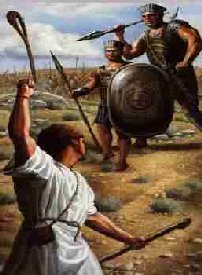 |
Goliath and these four were all descendants of Rapha in Gath, "and they fell at the hands of David and his men" (2 Samuel 21:22 and I Chronicles 20:8).
David apparently knew in facing Goliath that these other four might also have to be reckoned with. So David prepared himself to take down all five giants, one stone per giant, if need be. The Bible tells us that the other four did fight against David and his army in later battles, and all four were defeated.
David's stone was a bullet of faith, launched from his sling at probably 100 to 120 mph, and with sufficient momentum to break through Goliath's skull bones. The boastful giant never knew what hit him. The text indicates that David ran toward Goliath as he launched his shot, thus adding to its momentum. We can assume from David's success in killing both bear and lion that he was a fast runner (Goliath could never have caught him in open field running) and an accurate shot, probably able to put a stone into a 3- or 4-inch circle consistently from a distance of 20 or 30 feet (an accuracy comparable to that of today's pro baseball pitchers).
Rulers in ancient Egypt and Mesopotamia often proclaimed themselves as "sons of God" to enhance their power and prestige. So, another view with much support is that the "sons of God" were power-hungry rulers and despots, who, in their hunger for power and influence, took many wives in polygamy. They, and their offspring, through tyranny, became "mighty men." (Nimrod was described as a "mighty one" in Genesis 10:8.)
So, there is no need to
resort to fanciful suggestions involving aliens to
understand this passage of Scripture.
Good
Angels do not marry
A contradictory
yet enlightening statement about angel
marriages was made by Jesus which was
reported in Matthew 22:30; "For
in the resurrection they neither marry, nor
are given in marriage, but are as the angels
of God in heaven." Here we
read a statement from Jesus saying that
angels do not get married. A possible
explanation for this is that the "sons
of God" were the descendants of
Seth, and "the daughters of men"
were of the godless Cainites.
Remember, God later spoke of the people of
Israel as His ‘firstborn son" (Exodus
4:22), and Moses called the people of Israel
"children of the Lord your God"
(Deuteronomy 14:1).
Therefore, when they took wives it was an unholy alliance between Sethites (God's people) and Cainites (idol worshipers). Also, the word "wives" seems to indicate more that one and therefore a suggests taking more than one wife (polygamy).
Subscribe to:
Posts (Atom)